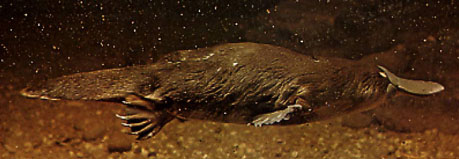
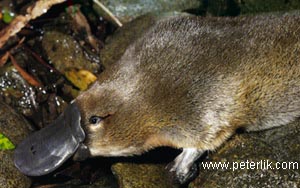
 Pride of place goes to the platypus, a creature
with very amazing features which are only seen in very diverse species: mammals -
mammary glands (all), three ear bones (all), beaver like tail, fur (many);
reptiles - cloaca (all) (however, it does have a uterus and as in birds,
only one of the ovaries is functional), egg laying (all), poison (snakes) spurs for
defense; birds - duck like bill (which is soft however), it breathes
through the bill like the duck, duck like webbed feet (however, these feet have
claws in the front and spurs in the back); fish - it has an amazing electro
receptor (paddle fish) in its bill which allows it to catch prey under water while
its eyes are closed and its hearing shut, it also has a very large
vocalization range more bird-like than anything found in other mammals (except
man). The platypus is perfectly designed for feeding and swimming in the water
and it has to be - it eats about half its weight in food a day! However, it lives
on land in burrows it digs with its claws and can also feed on insects and other
land creatures. To add to the uniqueness of the platypus, studies of its mtDNA
forced evolutionists to give upon mtDNA to 'prove' evolution. The studies showed
that it was closer to eutherian mammals (cows, men, etc.) than the marsupials (kangaroos, koalas).
Pride of place goes to the platypus, a creature
with very amazing features which are only seen in very diverse species: mammals -
mammary glands (all), three ear bones (all), beaver like tail, fur (many);
reptiles - cloaca (all) (however, it does have a uterus and as in birds,
only one of the ovaries is functional), egg laying (all), poison (snakes) spurs for
defense; birds - duck like bill (which is soft however), it breathes
through the bill like the duck, duck like webbed feet (however, these feet have
claws in the front and spurs in the back); fish - it has an amazing electro
receptor (paddle fish) in its bill which allows it to catch prey under water while
its eyes are closed and its hearing shut, it also has a very large
vocalization range more bird-like than anything found in other mammals (except
man). The platypus is perfectly designed for feeding and swimming in the water
and it has to be - it eats about half its weight in food a day! However, it lives
on land in burrows it digs with its claws and can also feed on insects and other
land creatures. To add to the uniqueness of the platypus, studies of its mtDNA
forced evolutionists to give upon mtDNA to 'prove' evolution. The studies showed
that it was closer to eutherian mammals (cows, men, etc.) than the marsupials (kangaroos, koalas).The platypus was discovered in the early 19th century and was quite a sensation. At first it was thought to be a fake. While well known, Darwin did not dare discuss it in his works. Clearly, he could not explain it away. However, the Australian Aborigenes do have a theory about the evolution of the platypus. According to one of their myths, the platypus resulted from a young female duck's disobedience. Duck lived with others of their kind in a sheltered river pond. All of them were in constant fear of Mulloka, the Water Devil, and never strayed far from their pond. But one day, against the advice of her elders, Duck ventured downstream and eventually found herself at a patch of grass on the riverbank. Unaware that this was the territory of the lonely Water-rat, she climbed out. Hearing duck, Water-rat emerged, threatened her with his spear and, dragging her underground, forced her to mate with him. By the time of egg-hatching, Duck was ashamed to have to lead out two extraordinary offspring. They had bills and webbed feet, but instead of two feet they had four and instead of feathers they had fur, while on each hind leg they had a sharp spike like Water-rat's spear. The first members of the platypus race were born.
Duke Univ.-Kangaroo and Platypus not Related
Platypus
Platypus Fact File
Rainforest Lodges - Platypus
Parks & Wildlife - Platypus
Monotremes
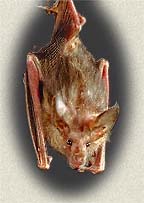 While
bats are unique in more than one way (they are the only mammal capable of powered
flight) what makes them quite unique, (and unexplainable to evolutionists) is
their echolocation. They have a totally amazing sonar by which they are able to
feed and to navigate. Because their sight is quite bad, they mostly fly at
night to avoid other predators. This sonar is so good that it is even better than
that of the US Submarine Fleet and is being studied by the armed forces in order
to make our sonar systems better. The bat is completely fit for flight. It has
very light bones like birds and unlike other mammals. Some of their bones are
reduced from those of other mammals and have fused cranial bones like birds to
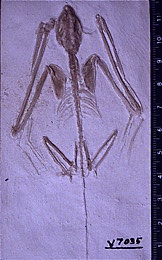
make them even lighter.Bat bones tend to be light and slender (which
accounts in part for the sparse fossil record of bats). As in birds, bats have
some reduced bones, the radius and fibula are shortened and thin. Bats,
like birds, also have fused cranial bones for additional lightness. The
arrangement of the muscles is also designed for lightness and for flight. Unlike
birds though, the bats's 'fingers' end in a claw to grasp. Their hind knees
point backward when bent unlike all other mammals. The first bat fossils from
the Eocene are completely modern looking and show the specializtion of the
auditory region required for echolocation.
While
bats are unique in more than one way (they are the only mammal capable of powered
flight) what makes them quite unique, (and unexplainable to evolutionists) is
their echolocation. They have a totally amazing sonar by which they are able to
feed and to navigate. Because their sight is quite bad, they mostly fly at
night to avoid other predators. This sonar is so good that it is even better than
that of the US Submarine Fleet and is being studied by the armed forces in order
to make our sonar systems better. The bat is completely fit for flight. It has
very light bones like birds and unlike other mammals. Some of their bones are
reduced from those of other mammals and have fused cranial bones like birds to
make them even lighter.Bat bones tend to be light and slender (which
accounts in part for the sparse fossil record of bats). As in birds, bats have
some reduced bones, the radius and fibula are shortened and thin. Bats,
like birds, also have fused cranial bones for additional lightness. The
arrangement of the muscles is also designed for lightness and for flight. Unlike
birds though, the bats's 'fingers' end in a claw to grasp. Their hind knees
point backward when bent unlike all other mammals. The first bat fossils from
the Eocene are completely modern looking and show the specializtion of the
auditory region required for echolocation.
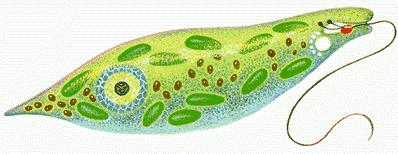 Euglena is a single celled
eukaryotic protist which is both a plant (has chlorophyll and makes its own food)
and an animal (is capable of self motion by means of a flagellar 'tail'). Oh yes,
it also has an eye spot which allows it to use light for directional purposes.
Quite a problem for evolution for several reasons. While bacteria are known to be
able to 'borrow' DNA from other bacteria, eukaryotes, because of their nucleus
and stronger cell walls cannot. As we know, one cannot descend from totally
disparate species.
Euglena is a single celled
eukaryotic protist which is both a plant (has chlorophyll and makes its own food)
and an animal (is capable of self motion by means of a flagellar 'tail'). Oh yes,
it also has an eye spot which allows it to use light for directional purposes.
Quite a problem for evolution for several reasons. While bacteria are known to be
able to 'borrow' DNA from other bacteria, eukaryotes, because of their nucleus
and stronger cell walls cannot. As we know, one cannot descend from totally
disparate species.
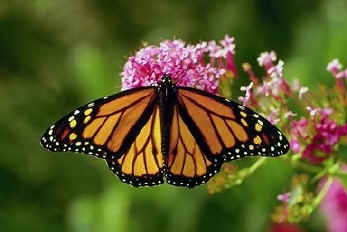 Butterflies, as we learned in school have a two stage process of
being born. First when they come out of the egg, they become caterpillars. They
then shed their outer skin and start transforming themselves into a pupa (cocoon)
after some two weeks, the butterfly is born in all its glory. This well known
fact is a serious problem for evolutionary theory. Evolution has long
claimed (in spite of this well known fact) that the process of gestation
and birth recapitulates evolution. However, other insects which arose much
earlier do not reproduce this way and just a few species reproduce this way
(frogs also reproduce after a transformation from egg to tadpole to frog,
but interestingly, almost identical looking frogs of the same genus are
born as tadpoles and by skipping the tadpole stage).
Butterflies, as we learned in school have a two stage process of
being born. First when they come out of the egg, they become caterpillars. They
then shed their outer skin and start transforming themselves into a pupa (cocoon)
after some two weeks, the butterfly is born in all its glory. This well known
fact is a serious problem for evolutionary theory. Evolution has long
claimed (in spite of this well known fact) that the process of gestation
and birth recapitulates evolution. However, other insects which arose much
earlier do not reproduce this way and just a few species reproduce this way
(frogs also reproduce after a transformation from egg to tadpole to frog,
but interestingly, almost identical looking frogs of the same genus are
born as tadpoles and by skipping the tadpole stage).

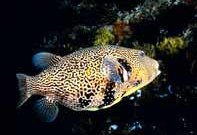
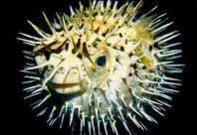 The fugu (also known as the pufferfish) was selected as
one of the first species to have their entire genome sequenced due to the
smallness of it. Like humans, it has some 30,000+ genes, however, its
genome is
only some 400 million DNA bases as opposed to the human's 3 billion DNA bases.
Scientists thought that this would
make it easier to learn from the puffer fish
how our genome works. Surprisingly,the fugu
genes are so much like ours - even
after some 400 million years of evolution since the fugu fish came about, that
scientists were able to discover some 1,000 new genes in humans from their
research on the fugu fish. This disproves the claim by evolutionists that the
non-coding DNA is 'junk', clearly our genes could not be so close and our bodies
so different if there was not something else in the non-coding regions that
effected these
changes. The closeness of our genes to the fugu also makes
comical the evolutionist's 'tree of life' and many of their supposed genetic
'proofs' of evolution.
The fugu (also known as the pufferfish) was selected as
one of the first species to have their entire genome sequenced due to the
smallness of it. Like humans, it has some 30,000+ genes, however, its
genome is
only some 400 million DNA bases as opposed to the human's 3 billion DNA bases.
Scientists thought that this would
make it easier to learn from the puffer fish
how our genome works. Surprisingly,the fugu
genes are so much like ours - even
after some 400 million years of evolution since the fugu fish came about, that
scientists were able to discover some 1,000 new genes in humans from their
research on the fugu fish. This disproves the claim by evolutionists that the
non-coding DNA is 'junk', clearly our genes could not be so close and our bodies
so different if there was not something else in the non-coding regions that
effected these
changes. The closeness of our genes to the fugu also makes
comical the evolutionist's 'tree of life' and many of their supposed genetic
'proofs' of evolution.