 Through the process of protein synthesis the DNA information is turned into the proteins which provide both the structure and the functioning of organisms. This essential role of protein manufacturing is accomplished by the translation of the DNA code from its 4 possible values by reading it in sets of three bases (called codons). This allows for 64 possible values in the DNA code and all of them are found in actuality. However there is only need for 20 values to represent the 20 amino acids used in protein formation, therefore most of the amino acids have more than one value to represent them in the code. Three code values are used as stop values signaling termination of protein synthesis.
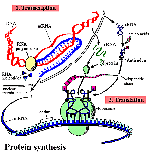 The process of protein synthesis starts with the transcription of DNA into messenger RNA. This transcription requires the use of RNA polimerases with steps similar to DNA transcription. RNA transcription however, has some additional problems that need to be overcome. Because DNA is entwined upon itself, RNA needs to determine the correct strand to transcribe. RNA also needs to determine the starting site of transcription. Because eukaryotes (higher species than bacteria) have numerous DNA base pairs in the middle of a gene sequence which are not used in the protein to be manufactured (introns), the process of RNA transcription requires the additional step of cutting out the extraneous codons and the splicing of the RNA strand into a single piece afterwards. The intron sequences are most often much larger in length than the sequences needed to make the protein.
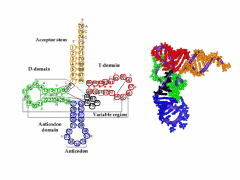 Protein synthesis is continued by the process of translation. On one side of the tRNA molecule, it is specifically designed to attach itself to a single amino acid. On the other end, each tRNA codes for a specific anticodon (the complement of a codon). It is therefore used as a bilingual dictionary finding one word (codon) and giving the other word (amino acid) as a result. Once a codon matching the tRNA is found, the ribosome attaches the amino acid to the growing chain which will make up the protein. One amino acid, methionine, usually (but not always) represents the starting codon for the production of proteins. Due to the special role of methionine in starting a protein chain, two different types of tRNA's are required for producing it, one if at the start and one if it occurs in the middle of a chain [1962b]. The role of translation is done rather inelegantly. It requires numerous tRNA's to match with the different possible codes. In humans over 400 different genes produce the different tRNA's required for translation.[1962c]
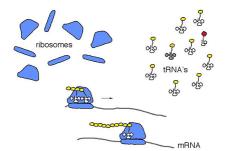 Under major codon preference, codon usage and tRNA pools are co-adapted to enhance the efficiency of translation. During protein synthesis, the translational apparatus waits at a given codon for the appropriate tRNA to arrive, then links the (yellow) amino acid to the elongating polypeptide. The waiting time is shorter at major codons which are recognized by abundant (unshaded) tRNAs. Shorter waiting times increase the rate of elongation of the polypeptide and decrease the probability that an incorrect amino acid will be incorporated into the protein.[1962d]
 The amino acids which make proteins have different properties such as hydrophobia, polarity, acidity, and positive/negative charge. These properties are a result of the different chemical compositions. However, their similarities should not be ignored. Like DNA which due to the similarities of chemical composition is able to be arranged in all possible ways while coding different values, amino acids, due to their similarities can also be joined in all possible ways to provide different functionality. How these properties influence protein folding, an important feature of proteins, was the reason for the [1962e] chemistry prize to Max Perutz and John Kendrew for decades of work on determining the structural results of the chemical composition of hemoglobin and myoglobin through the use of X-ray crystallography.
The emergence of such a model even for a single protein, such as myoglobin, makes it possible to test and to add precision to the chemist's generalizations. Already sperm whale myoglobin is being studied by biochemists in a number of laboratories with this end in view; to give only a few examples, it is being examined from the standpoint of optical rotatory power and helix content, of titration behavior, of metal binding, chemical modification of side chains, of hydrodynamic characteristics. Such studies, and others like them, will serve to deepen our understanding of the ways in which proteins behave and of the reasons why they are uniquely capable of occupying so central a position in living organisms. The geneticists now believe - though the point is not yet rigorously proved - that the hereditary material determines only the amino acid sequence of a protein, not its three dimensional structure. That is to say, the polypeptide chain, once synthesized, should be capable of folding itself up without being provided with additional information; this capacity has, in fact, recently been demonstrated by Anfinsen in vitro for one protein, namely ribonuclease. If the postulate is true it follows that one should be able to predict the three dimensional structure of a protein from a knowledge of its amino acid sequence alone. Indeed, in the very long run, it should only be necessary to determine the amino acid sequence of a protein, and its three dimensional structure could then be predicted; in my view this day will not come soon. ...
proteins are unique in combining great diversity of function and complexity of structure with a relative simplicity and uniformity of chemical composition. In determining the structures of only two proteins we have reached, not an end, but a beginning; we have merely sighted the shore of a vast continent, waiting to be explored.
[1962f]
.
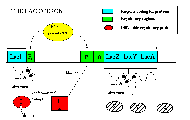 Francois Jacob, Andrew Lwoff and Jacques Monod won the[1965] Prize for two related discoveries. One was the discovery of messenger RNA already discussed above. The other was the discovery of the lac(tose) operon. In their research to try to find out how genes were expressed, they found in E-coli bacteria a set of genes which were variably expressed according to whether there was glucose or lactose in the system to be processed. If there was glucose, the operon, a set of DNA near the three genes which produced the proteins for using lactose would be rendered inactive and would not allow RNA polymerase to get to the three genes downstream from it and make proteins from them. If there was lactose present, then the operon would be active and allow the production of the required proteins. While it was surmised by scientists that there had to be a mechanism to control when genes produced proteins, this was the first proven example of how such a system worked. The regulation of genes has become a central part of biological research nowadays, but this was the first demonstration of how such regulation occurs.
The contributions of Robert Holley, Ghobind Khorana, and Marshall Nirenberg in the elucidation of protein synthesis thoroughly deserved the [1968] Nobel Prize. They not only discovered messenger RNA, transfer RNA, but also which amino acids are designated by each of the three letter codes. They also determined that the translation of the code was universal amongst different organisms ranging from mammals to humans.
What then is the genetic code and why is it called the code of life? Nucleic acids are very complicated molecules, but their structure shows certain regularities. They are constructed from a limited amount of smaller building blocks. If we compare a nucleic acid with a language, we can think of the building blocks as the letters of the alphabet of the language. With this analogy, we may say that the language of nucleic acids in the cell describes our inherited traits. It tells us if our eyes and those of our children are blue or brown, if we are healthy or sick.
There also exists a second language in our cells: the language of proteins, written in the alphabet of proteins. A single cell contains many thousands of proteins which perform all the chemical reactions required for the normal life of the organism. The synthesis of each protein is directed by a particular nucleic acid. A brown-eyed child receives from its parents nucleic acids which have the ability to direct the formation of proteins required for the synthesis of dark pigment of the eye. It is the chemical structure of the nucleic acid which determines the chemical structure of the protein; the alphabet of nucleic acids dictates the alphabet of proteins. The genetic code is the dictionary which gives us the translation of one alphabet into the other.[1968]
The [1970] Peace Prize to Norman Borlaug shows quite well a few interesting facts about breeding and genetics. Borlaug's efforts in breeding new rice and other varieties of grains resulted in doubling and tripling of grain production in much of Asia. The new breeds used less fertilizer to produce higher yields and were also more resistant to pests. This came about by the development of a Mexican Dwarf variety of wheat by breeding it with Japanese wheat. This joining of different varieties produced a more resilient wheat. Further work in other countries in mixing local wheats to the Mexican Dwarf varieties, showing that interbreeding of populations results in better progeny and that selection without mutation can produce new variations more adapted to environmental conditions.
The current agronomic research on wheat in India equals the best in the world. The breeding program is huge, diversified, and aggressive; already it has produced several varieties which surpass those originally introduced from Mexico in 1965. The first group of new Indian varieties, already in extensive commercial production, were derived from selections made in India from partially selected materials received from Mexico. A second group of varieties, now being multiplied, are selections from crosses made in India between Indian and Mexican varieties. The rapidity of creation and distribution of these new varieties has already diversified the type of resistance to diseases and therefore minimizes the menace of destructive disease epidemics if and when changes occur in parasitic races of the pathogens.[1970a]
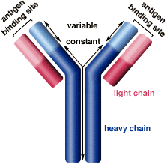 Gerald Edelman and Rodney Porter received the [1972] Prize for discovering the structure of immunoglobins, the proteins which bind to foreign agents. The specificity of immunoglobulins is very high, they must match exactly to the foreign body being attacked. Not only do they recognize bodies foreign to a species, but as problems with organ transplants have shown, to organisms of the same species not closely related. The mystery as to how such specificity was achievable is due to the structure of the immunoglobulins. They give us another elegant example of variation within a specific theme similar to what we saw in DNA and the amino acids. The structure of the immunoblobulins is separated into a constant stem section to which are joined variable arms. It is at the tip of these arms where the immunoglobulins join the foreign bodies that the variation occurs. For the genetic basis of immunoglobulin formation, we must wait another 15 years for the work done by Susumu Tonegawa.
Christian Anfinsen, Stanford Moore and William Stein showed how the chemical properties of the amino acids in a protein influence their folding. For this they won the [1972] Prize. They proved the hypothesis that the three dimensional structure of a protein is determined by the interatomic interactions in its destined milieu and hence by the amino acid sequence. They showed this by denaturing (breaking up) a ribonuclease into an unfolded position by use of chemical agents to break the internal bonds of the protein. When the chemical agents were removed, the protein re-folded itself into its original conformation. Since much of the work of proteins depends on their shape and structure, as well as any chemical or catalytic properties it may require to do its work, the order of amino acids must be such that they will insure the correct shape of the protein as well as any other properties required for it to accomplish its function.
 In their work on bacteria Werner Arber, Daniel Nathans, and Hamilton Smith discovered the presence of DNA which could not be expressed. Their discovery and work on restriction enzymes won them the [1978] Prize. The primary genetic suppressor used is methylation. A process which provides the Cytosine in DNA with a methyl group of one carbon and three hydrogens. This serves to indicate to RNA polymerase that the sequence is not to be transcribed into protein thus silencing the gene. These scientists identified a large group of proteins that were able to accomplish this silencing, by now they number over 900. The need for so many is that they only bind to specific DNA sequences. The importance of their work and their specificity in both life and research is that in the lab it allows the selective silencing of portions of DNA being studied to better understand how an organism works. This is a vast improvement over the non-specific radiation methods used previously and thus speeds up research. In life they solve the problem of how different cells with the same genes are specified to do different work.
Methyl group tags in the DNA of humans and other mammals play an important role in determining whether some genes are or are not expressed. Genes unnecessary for any given cell's function can be tagged with the methyl groups. The number and placement of the methyl tags provides a signal saying that the gene should not be expressed. ...
As would be expected from something important in determining which genes are used by our cells, DNA methylation is essential for the normal development and functioning of organisms. This has been shown by engineering mice that can't make the enzymes which put the methyl tags on DNA, called methyltransferases. These mice die before birth. Problems with the DNA methylation machinery also cause developmental diseases in people. People with mutations causing abnormal function of one of the DNA methyltransferase enzymes called Dnmt3b have a disease called ICF syndrome. These people have abnormal immune systems and other genetic problems. Similarly, abnormalities in one of the proteins recognizing and binding mC (called MeCP2) develop Rett syndrome, a form of mental retardation affecting young girls. Hence, we cannot develop and function normally without DNA methylation.
[1978a]


 In [1962] James D. Watson, Francis Crick and Maurice Wilkins were awarded the Nobel Prize for their 1953 discovery of DNA structure. They showed that it is arranged in a stepwise chain of paired DNA bases. This chain is the template for all genetic information of an organism. From this template protein synthesis occurs by the copying of the DNA bases onto messenger RNA. The messenger RNA then exits the nucleus of the cell and is read in the ribosomes where specified translating RNA, one for each of the 20 amino acids reads the codons and specifies which amino acid is to be added to the protein chain being manufactured by the ribosome.
